The Importance of File Naming
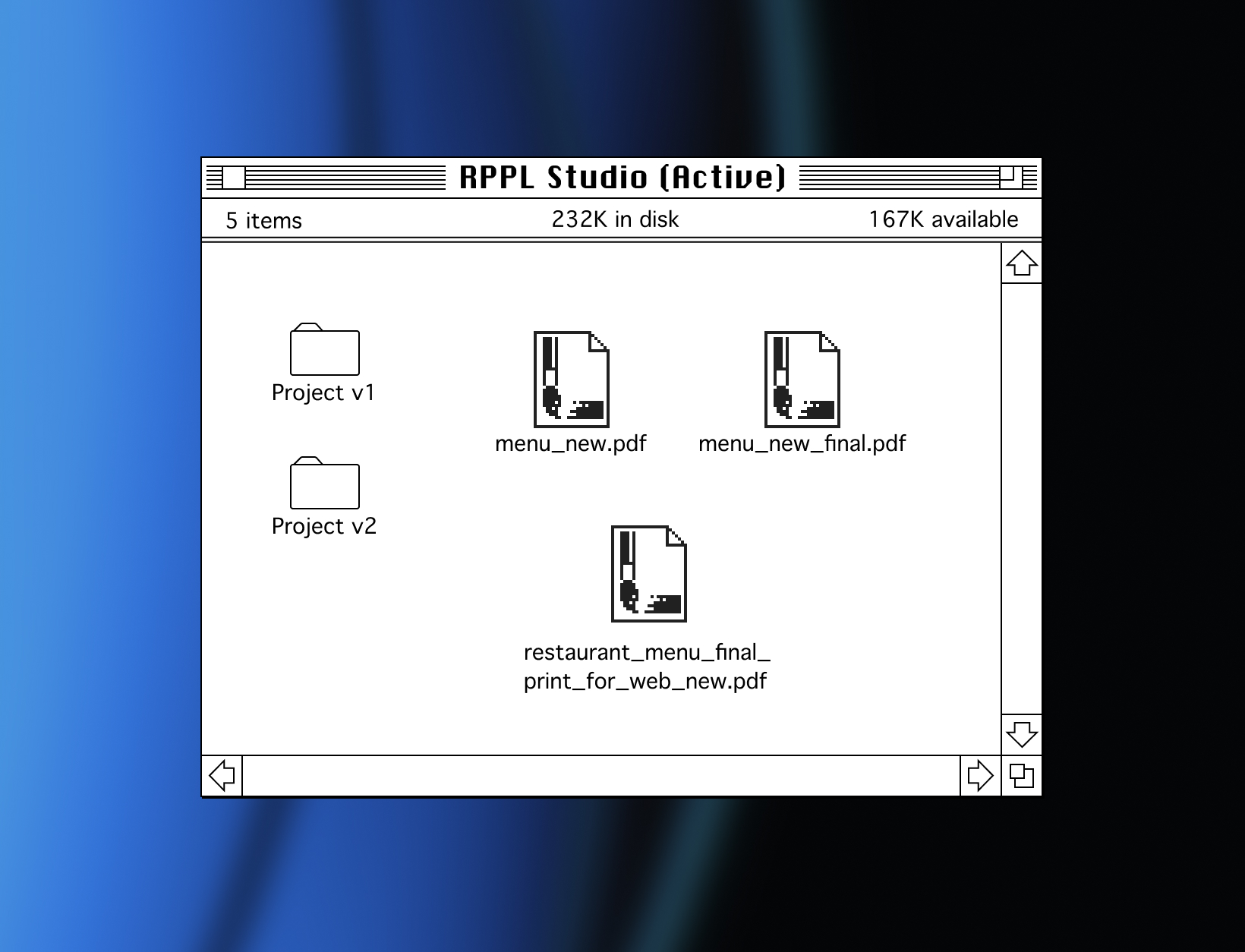
A restaurant spends months on its menu — the typography, the paper stock, the way “Blackened Shrimp Salad” sits next to its price. Then someone exports the PDF and it lands in a customer’s phone as menu_new.pdf.
That’s not a hypothetical. It’s the actual file name behind a polished menu from a restaurant we’ll call Wren & Oak. From a different kitchen, another guest received 2509-071_Rosetta_Dinner_8.5x14_r3.pdf — a print-shop job code, revision number, and paper size, dumped straight into their phone.
Neither name was written for the person receiving it. One reads like a placeholder nobody remembered to fix. The other reads like an internal production ticket that escaped into the wild. Both undercut, in a small but real way, everything the design work was trying to do.
The file name is part of the interface
Designers think carefully about first impressions — the plate, the storefront, the homepage hero image. But by the time a menu, invoice, or proposal reaches someone as a file, the interface has quietly changed. It’s no longer the PDF’s layout doing the talking; it’s the operating system. iMessage, Mail, Google Drive — they all surface the file name before anyone taps to open it. That string of characters is the first impression now, and it’s one most teams never design at all.
This is the same principle that governs the rest of a buyer journey: every touchpoint either builds trust or quietly erodes it. A guest doesn’t consciously register “unprofessional.” They register a flicker of “hm, that’s odd” — and that flicker is friction. It’s the digital equivalent of a beautiful dining room with a taped-up sign in the window.
Control what you can control
The frustrating part is how solvable this is. A file name is one of the cheapest touchpoints a business has, and one of the only ones entirely within its control. You don’t need a redesign to fix it — you need a naming convention and someone who checks the export before it goes out the door.
Something like Wren-and-Oak-Menu.pdf costs nothing extra to produce. It’s legible in a text thread, searchable later, and it signals that the same care applied to the food was applied all the way through. Job codes and revision numbers are useful — they just belong in the production folder, not in the file a customer ends up holding.
It’s not just manners — it’s discoverability
File names aren’t only read by humans glancing at a phone screen. They’re read by machines deciding what to surface. Google has indexed PDFs for years, and the file name is one signal it uses to understand what a document is about. menu_new.pdf tells a search engine nothing; wren-and-oak-menu.pdf tells it exactly what the page is and where it belongs.
That logic now extends to answer engines. When someone asks ChatGPT or Perplexity what’s on a restaurant’s menu, those systems pull from crawled content and cite sources — and a clearly named file is easier to identify and attribute. This is the core of AEO, Answer Engine Optimization: the same fundamentals as SEO, aimed at being understood and quoted by an AI rather than just ranked. A vague file name doesn’t just underperform in search — it makes a business harder to cite at all.
Same problem, on the website
The same file gets uploaded to a website, and the naming problem doesn’t go away — it just changes shape. A menu PDF linked as menu_new.pdf shows up that way in a browser tab, a downloads folder, and a shared link preview. A hero image saved as IMG_2306.jpg carries no information into its alt text, its file path, or the thumbnail Google shows in image search. Neither one tells a browser, a search engine, or a person anything about what they’re looking at before they click.
Thumbnails make this worse, because they’re often auto-generated from whatever name happens to be attached. Share a link on iMessage, Slack, or LinkedIn, and the preview card frequently pulls the file name in alongside the image — so 2509-071_Rosetta_Dinner_8.5x14_r3.pdf doesn’t just sit quietly on a server, it re-announces itself every time someone forwards the link. The fix is the same one as the menu: wren-and-oak-dining-room.jpg instead of IMG_2306.jpg, wren-and-oak-menu.pdf as the linked file, an alt tag that describes the actual photo. Small, unglamorous, done once at upload.
The principle scales
This isn’t really about menus. A “buyer journey” doesn’t end at the polished deliverable — it ends wherever the buyer actually experiences the thing, often a step further downstream than the design process accounts for. A file name, a subject line, a URL slug — these are the unglamorous last few feet of a journey that started with real intention. They’re easy to overlook because they don’t feel like “design.” But they’re exactly the kind of detail a business can get right, cheaply and consistently.
Good design isn’t just what happens on the canvas. It’s what survives contact with export settings and someone else’s phone.