How to Navigate a Successful Rebrand

A rebrand is often associated with a new logo, color palette, or website. But the most successful rebrands go much deeper. They create greater clarity around who a company is, who it serves, and where it wants to go.

At RPPL Studio, we see rebranding as an opportunity to connect business strategy with meaningful creative expression. Here are a few principles to keep in mind when navigating the process.

Start with the “why.”

Before changing anything visually, understand why the brand needs to change. Has the business evolved? Are you entering a new market? Has your audience changed? Is the current brand no longer communicating the value you provide?

Starting with these questions helps ensure the rebrand addresses a real business need rather than simply creating a new look. Brand strategy provides the foundation for making those decisions with intention.

Get aligned.

A successful rebrand requires more than the approval of a few key stakeholders. Leadership, marketing, sales, product, and other teams may all interact with the brand differently.

Research, stakeholder interviews, competitive analysis, and audience insights can help create a shared understanding of the opportunity—and give the creative work a stronger foundation.

Define what should change.

Not everything about an existing brand needs to disappear. Some elements may have significant recognition or equity.

The goal is to understand what should be preserved, what needs to evolve, and what needs to be left behind. Sometimes that means a refinement of the existing identity. Other times, it calls for a more fundamental repositioning.

Build a system, not just a logo.

A strong identity needs to work beyond the presentation deck. It should provide a flexible brand identity system for websites, digital products, campaigns, social media, sales materials, presentations, environmental applications, and whatever comes next.

The logo is only one piece of the puzzle. The real value comes from creating a system that helps an organization communicate consistently and confidently.

Make the brand real.

Launching the new identity is only the beginning. Employees need the tools and guidance to use it, and customers need to experience it consistently across every touchpoint.

That means thinking about digital experiences, websites, and products, content, governance, and ongoing optimization—not just launch day.

Measure what matters.

Finally, success shouldn’t be measured by whether people simply like the new logo. A rebrand should support meaningful business outcomes, from stronger brand perception and engagement to improved digital performance, lead generation, and customer conversion.

A successful rebrand isn’t simply about looking different. It’s about creating a clearer, more relevant, and more useful expression of the business—and building a brand that can grow with it.

Small by Design: The RPPL Model

Post 2 in a series on why we started RPPL Studio

There’s an assumption people carry around about agency size: smaller means less capable. Thinner bench, fewer resources, a step down from “the real thing.” Backwards. Here’s how we built the thing we built.

Small isn’t the fallback. It’s the choice.

Everyone on a small team is there because of the work they’ve already done — not because a training seat was open. Compare that to a big agency, where your budget quietly decides how senior your team gets to be. Smaller budget, more junior people learning on your dime.

Fewer people doesn’t mean fewer opinions worth trusting. It means faster ones. The person deciding is the person doing the work — not someone two layers up, passing the idea from account to creative to production and losing a little of it at every handoff.

And a lot of what you’re paying for at a big agency isn’t more talent. It’s more structure sitting on top of it. Take that away and you’re getting the same level of experience with nothing standing between it and you.

What that looks like

My two co-founders and I worked together for years before RPPL existed, in the same roles we hold now: ops and sales, creative, production. We weren’t betting on potential when we started this — we were building around something we’d already proven.

If you caught the first post in The Long Way to RPPL, you know part of how we got here — the culture at our old agency wasn’t always what it became, and watching that shift was part of why we left. What matters here is what we did once we were out. One of our first priorities was bringing on the very people who had been treated as expendable, grounding our studio in a simple reality: if experience is the asset, you show it by valuing the people who carry it.

We could’ve rebuilt something that looked like what we left. We didn’t, on purpose. Every structural problem from the last post — the approvals, the account-versus-creative tug of war, staffing built around utilization instead of fit — we’d lived inside all of it, and we weren’t interested in recreating it. Staying small isn’t a phase. It’s the model.

The whole thesis, boiled down: the work gets better, and the people doing it matter more, the closer they stay to it. We didn’t build RPPL to test that idea. We already believed it — this was the only way to live it out.

Small by Design: The Great Talent Exodus

Why the Future Belongs to Studios, Not Monoliths

Post 1 in a series on why we started RPPL Studio

Here’s something I keep noticing: the people who make big agencies good at what they do are leaving. Not for a bigger, shinier competitor. For something smaller.

I don’t think that’s a coincidence. It’s a pattern, and once you start looking for it, you see it everywhere in this industry right now.

The ground is shifting under the big shops

The past year or so has been full of headlines about the big holding companies merging, restructuring, cutting headcount, retiring agency names that have been around for decades. Some analysts are forecasting a real, double-digit drop in agency jobs industry-wide this year.

What matters more to me than the numbers: those cuts aren’t landing evenly. It’s the senior people — the ones who ran the accounts, led the creative, held client relationships together — who tend to get caught in it. When a company gets absorbed into something bigger, it’s rarely the process and the layers that go first. It’s the people.

So where do they go?

You’d think the next step for someone with that kind of experience is another big agency. Increasingly, it isn’t. A lot of that talent is landing at smaller, independent studios instead — places that can offer something the giants, busy trying to integrate and consolidate, genuinely can’t right now: speed, focus, and senior people who are still doing the work instead of managing eight layers of people who are.

I read a line recently from someone who consults on agency pitches, describing why independents are starting to win business away from the big names: no endless rounds of internal alignment, and no chance your account gets handled by an algorithm somewhere down the chain. Not meant as a dig — just an honest description of what clients are choosing when they choose small. From where I sit, it tracks.

It’s bigger than “big vs. small”

Worth being honest about: a lot of that same talent isn’t only heading to studios like ours. A good chunk is going in-house, straight to brands, some of whom have built creative teams that rival actual agencies in scope and skill.

Which tells me this isn’t really a “small studios are stealing big agency talent” story. It’s simpler than that. Talented people are leaving rigid, bureaucratic places, period — wherever those places happen to be.

Why we started RPPL

We didn’t start this studio because we thought the big agency model was evil. We started it because we’d spent years watching, up close, what actually happens to good work and good people inside a machine built for scale instead of speed. Approvals multiply. Account and creative pull in opposite directions. The people doing the best work end up buried under the people managing the process of doing the work.

So when I look at what’s happening across the industry right now, it doesn’t feel surprising. It feels like confirmation of something we already knew. People go where the work — and the people doing it — still get to matter.

Next up: why the big agency model actually slows down in the first place. Not a complaint about culture — a look at the structure itself.

Named to Be Found

The Importance of File Naming

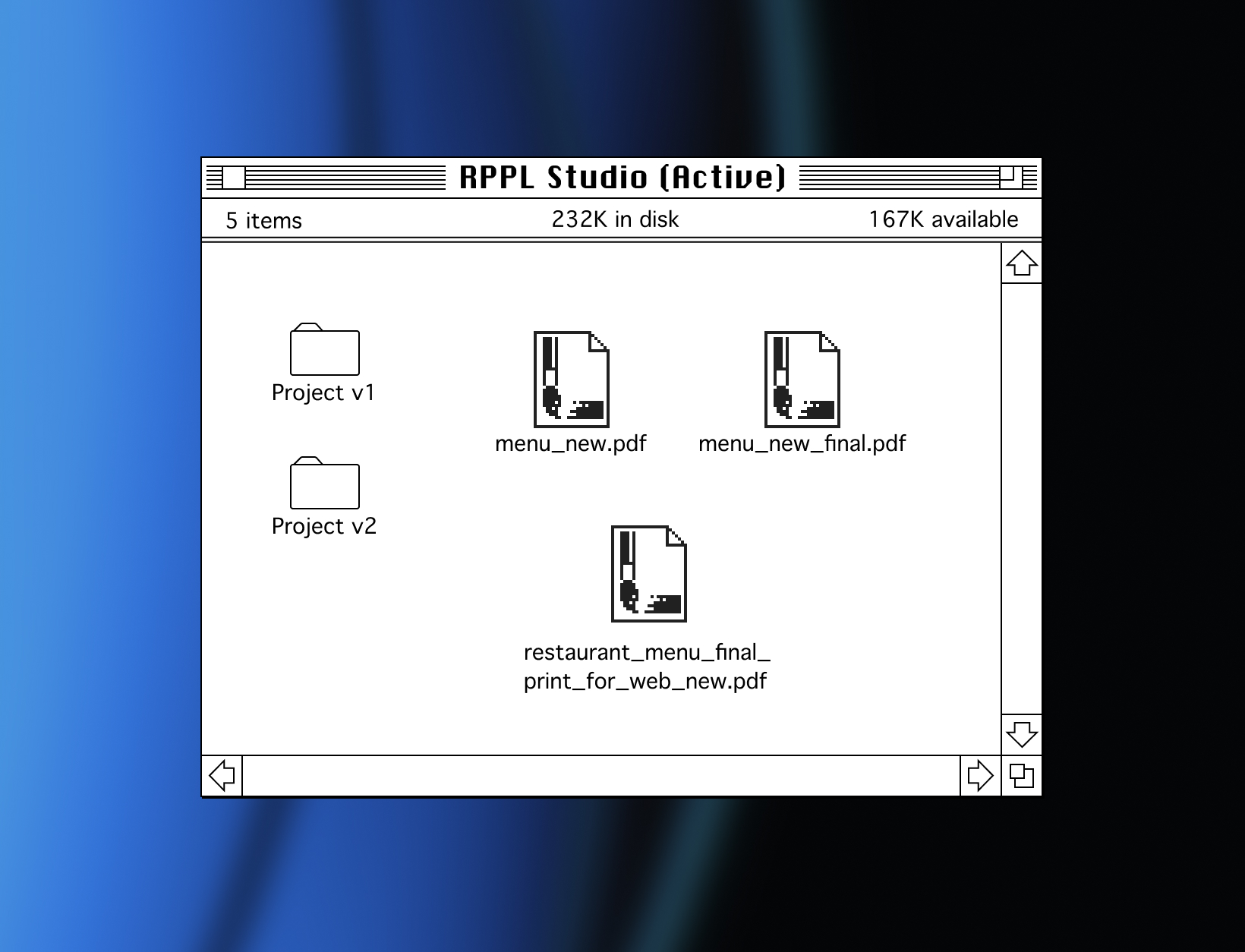
A restaurant spends months on its menu — the typography, the paper stock, the way “Blackened Shrimp Salad” sits next to its price. Then someone exports the PDF and it lands in a customer’s phone as menu_new.pdf.

That’s not a hypothetical. It’s the actual file name behind a polished menu from a restaurant we’ll call Wren & Oak. From a different kitchen, another guest received 2509-071_Rosetta_Dinner_8.5x14_r3.pdf — a print-shop job code, revision number, and paper size, dumped straight into their phone.

Neither name was written for the person receiving it. One reads like a placeholder nobody remembered to fix. The other reads like an internal production ticket that escaped into the wild. Both undercut, in a small but real way, everything the design work was trying to do.

The file name is part of the interface

Designers think carefully about first impressions — the plate, the storefront, the homepage hero image. But by the time a menu, invoice, or proposal reaches someone as a file, the interface has quietly changed. It’s no longer the PDF’s layout doing the talking; it’s the operating system. iMessage, Mail, Google Drive — they all surface the file name before anyone taps to open it. That string of characters is the first impression now, and it’s one most teams never design at all.

This is the same principle that governs the rest of a buyer journey: every touchpoint either builds trust or quietly erodes it. A guest doesn’t consciously register “unprofessional.” They register a flicker of “hm, that’s odd” — and that flicker is friction. It’s the digital equivalent of a beautiful dining room with a taped-up sign in the window.

Control what you can control

The frustrating part is how solvable this is. A file name is one of the cheapest touchpoints a business has, and one of the only ones entirely within its control. You don’t need a redesign to fix it — you need a naming convention and someone who checks the export before it goes out the door.

Something like Wren-and-Oak-Menu.pdf costs nothing extra to produce. It’s legible in a text thread, searchable later, and it signals that the same care applied to the food was applied all the way through. Job codes and revision numbers are useful — they just belong in the production folder, not in the file a customer ends up holding.

It’s not just manners — it’s discoverability

File names aren’t only read by humans glancing at a phone screen. They’re read by machines deciding what to surface. Google has indexed PDFs for years, and the file name is one signal it uses to understand what a document is about. menu_new.pdf tells a search engine nothing; wren-and-oak-menu.pdf tells it exactly what the page is and where it belongs.

That logic now extends to answer engines. When someone asks ChatGPT or Perplexity what’s on a restaurant’s menu, those systems pull from crawled content and cite sources — and a clearly named file is easier to identify and attribute. This is the core of AEO, Answer Engine Optimization: the same fundamentals as SEO, aimed at being understood and quoted by an AI rather than just ranked. A vague file name doesn’t just underperform in search — it makes a business harder to cite at all.

Same problem, on the website

The same file gets uploaded to a website, and the naming problem doesn’t go away — it just changes shape. A menu PDF linked as menu_new.pdf shows up that way in a browser tab, a downloads folder, and a shared link preview. A hero image saved as IMG_2306.jpg carries no information into its alt text, its file path, or the thumbnail Google shows in image search. Neither one tells a browser, a search engine, or a person anything about what they’re looking at before they click.

Thumbnails make this worse, because they’re often auto-generated from whatever name happens to be attached. Share a link on iMessage, Slack, or LinkedIn, and the preview card frequently pulls the file name in alongside the image — so 2509-071_Rosetta_Dinner_8.5x14_r3.pdf doesn’t just sit quietly on a server, it re-announces itself every time someone forwards the link. The fix is the same one as the menu: wren-and-oak-dining-room.jpg instead of IMG_2306.jpg, wren-and-oak-menu.pdf as the linked file, an alt tag that describes the actual photo. Small, unglamorous, done once at upload.

The principle scales

This isn’t really about menus. A “buyer journey” doesn’t end at the polished deliverable — it ends wherever the buyer actually experiences the thing, often a step further downstream than the design process accounts for. A file name, a subject line, a URL slug — these are the unglamorous last few feet of a journey that started with real intention. They’re easy to overlook because they don’t feel like “design.” But they’re exactly the kind of detail a business can get right, cheaply and consistently.

Good design isn’t just what happens on the canvas. It’s what survives contact with export settings and someone else’s phone.

Part 5: What We Bring to Every Project

Part 5 of “The Long Way to RPPL: What Positive Culture Actually Looks Like” — the final post in a series on two decades in the creative industry, and what they taught me about building a company on purpose.

If you’ve read the rest of this series, you already know the throughline: two decades of studios and agencies, some that got culture right and some that didn’t, each one teaching me something I couldn’t have learned any other way. RPPL Studio is where all of it landed. Not as a mission statement we workshopped in a conference room—it was workshopped remotely—, but as an actual operating principle we test against every client, every project, and every person we bring on.

It comes down to three things, the same three things I’ve been circling since Post 1: treat everyone as an equal team member, listen to their ideas regardless of where they sit, and never take advantage of the trust someone places in you when they choose to work with you.

That sounds simple. In practice, it shows up in small, specific ways almost every week. It shows up when a designer two weeks into a project pushes back on a creative direction I’m attached to, and the answer is to actually consider it rather than pull rank. It shows up in how we scope and price work — clearly, honestly, without padding or games, because the people we work with deserve to know exactly what they’re paying for and why. It shows up in how we built the team itself: not by hiring the cheapest available talent, but by bringing in people we already trusted, people who’d proven they do excellent work and deserved to do it somewhere that valued them properly.

It also shows up in how we work with clients. Every one of us at RPPL came up through agencies where the client relationship could tip into something transactional — where the goal quietly becomes managing the client rather than serving them well. We do the opposite on purpose. We tell clients the truth about their brand, their product, their idea, even when it’s not what they came in expecting to hear, because that’s the same principle I learned interfacing with CEOs at The Seventh Art all those years ago: real trust isn’t built by agreement, it’s built by honesty.

None of this makes us unique in some grand sense. Plenty of studios say similar things. What I’d point to instead is the fact that we didn’t arrive at these principles as branding. We arrived at them the long way — through the specific rooms I’ve walked through in this series, the good ones and the difficult ones, the mentors who modeled something better and the moments where nobody did. Every one of those experiences got folded into how we actually run this business day to day.

That’s ultimately why we’re so excited about the work in front of us. Not because the client roster is interesting, or the brands are ambitious, or the design challenges are fun — though all of that’s true too. We’re excited because we get to do this work the way we always believed it should be done, with people we respect, for clients who deserve honesty, inside a culture we built specifically because we know exactly what the alternative costs.

If there’s one thing I’d want a reader to take from this whole series, it’s this: positive culture isn’t a perk, and it isn’t a values page. It’s a series of decisions, made over and over, about how you treat the people in front of you — the junior designer with a better idea, the CEO who needs to hear something they don’t want to, the teammate who’s been treated as expendable somewhere else. Get enough of those decisions right, consistently, over enough years, and eventually you get something worth building on purpose.

That’s RPPL. That’s the long way we took to get here. And it’s the reason every project we take on gets the same thing from us: people who are paying attention, who mean what they say, and who are genuinely glad to be doing this work — with you.

Part 4: Building the Culture We Wished We’d Had

Part 4 of “The Long Way to RPPL: What Positive Culture Actually Looks Like” — a series on two decades in the creative industry, and what they taught me about building a company on purpose.

By the end of my time at Big Drop, I’d learned everything I needed to know about the kind of studio I wanted to build. Not from a lecture or a case study, but from years of paying close attention — to what worked, to what didn’t, to how people showed up when they were trusted and respected, and how they showed up when they weren’t. That kind of education doesn’t come cheap, and it doesn’t come easy. But it’s the most valuable thing I took from that chapter of my career.

Eventually, the direction I wanted to take and the direction the company was taking stopped lining up. That happens. Companies change, people change, and sometimes the version of a place you fell in love with isn’t the version you’re standing in anymore. I’ve made my peace with that. What I took from it wasn’t resentment — it was clarity. I knew, with more certainty than I’d ever had before, exactly what I wanted to build next.

Here’s the part I haven’t said yet in this series: by the time I made the decision to leave, RPPL already existed. I’d formed it months earlier with two people I’d worked alongside for years, each of us running a different piece of the business — one leading operations and sales, one leading production, me leading creative. We weren’t waiting around for a plan to fall into place. We already had one, quietly, in motion, built around exactly the principles this whole series has been circling: listen to people regardless of title, tell the truth regardless of power, treat people as equal contributors instead of disposable resources.

So when the moment came to actually leave, we already knew what we wanted to build instead. And we knew, immediately, who we wanted to build it with.

The designers and developers we brought on early were people I’d worked with before — genuinely excellent at what they did, and people I knew deserved to be part of something built with more intention than what they’d experienced elsewhere. So we made a decision early on that wasn’t complicated at all, even though it would have been easy to overthink: we went and hired them.

We hired them because they were excellent at what they did, and because we knew exactly what it would mean to the people on the other end of that offer to be valued and respected in more ways than one. If the last chapter of this series was about watching a culture erode from the outside, this chapter is about what happens when you decide to build the culture yourself, on purpose, from day one.

That’s the thing about starting something new after fifteen years of collecting lessons the hard way: you don’t get to pretend you don’t know better. I’d learned, across every studio and agency I’d worked at, exactly what good culture looks like and exactly what it costs when it’s missing. RPPL Studio wasn’t an abstract idea about “positive company culture.” It was a direct response to everything I’d watched happen, and hadn’t been able to fully fix, everywhere else.

We built it around the same three things this whole series keeps coming back to: treat everyone as an equal team member, listen to their ideas regardless of where they sit, and never — under any circumstance — take advantage of the trust people put in you when they choose to work with you. That’s not a mission statement we wrote for a website. It’s the actual operating principle, tested against every job I’d had before it, and against the very people we chose to bring with us.

Next: what “positive culture” looks like in practice at RPPL today, and why it’s the thing we’re most excited to bring to every project we take on.

Part 3: When the Culture You Trusted Starts to Slip

Part 3 of “The Long Way to RPPL: What Positive Culture Actually Looks Like” — a series on two decades in the creative industry, and what they taught me about building a company on purpose.

Big Drop is where I grew the most as a creative — and where I learned the hardest lessons about integrity.

I started there as a Lead Designer, working closely with the UI and UX teams to shape a holistic vision for each project rather than just executing whatever came down the pipeline. Over time, I used what I’d built up over the previous decade — the print discipline from KPF, the brand instincts from Berry Creative, the client-facing composure from The Seventh Art — to introduce and build out something that hadn’t existed there before: an entire branding services arm. Before that, Big Drop was strictly a web design shop. Watching that grow from an idea I pitched into a real, functioning part of the business was one of the most rewarding things I’ve done in my career.

For a while, the culture matched the ambition. It was the kind of place where good ideas could come from anyone, where the people at the top treated the people doing the work like partners rather than resources. I leaned into everything I’d learned up to that point — listening to my team, treating clients with honesty instead of deference, building an environment where people felt like equal contributors instead of cogs.

But cultures aren’t static, and they don’t sustain themselves. Over time, some of the people who had built and protected that culture moved on. And as they left, I watched something shift. Priorities shifted, in ways both subtle and not, and the quality of life that had once felt like a given started to feel less certain.

That shift is ultimately what led to my departure. Not one dramatic moment, but a slow recognition that I could keep fighting for a culture from the inside only so long before I needed to go build one from scratch instead.

That’s the part of this story that matters most for this series. I didn’t leave because the work stopped being interesting — the branding arm I’d built was thriving, the clients were incredible, the creative output was some of the best of my career. I left because I’d learned, the hard way, that culture isn’t something a company earns once and keeps forever. It has to be protected, deliberately, by the people in the room — and when the people protecting it leave or lose interest, it erodes fast, no matter how good the work still looks on paper.

I didn’t know it yet, but that recognition — that I’d rather build something small and intentional than keep defending something large and drifting — was the last piece I needed before starting RPPL Studio.

Next: the decision to leave and build something new, and what “positive culture” actually means when you’re the one responsible for creating it instead of just protecting it.

Part 2: Integrity at Scale

Part 2 of “The Long Way to Rppl: What Positive Culture Actually Looks Like” — a series on two decades in the creative industry, and what they taught me about building a company on purpose.

Landing at The Seventh Art as Digital Design Director felt like another one of those milestone moments — the kind I’d chase a few times over the course of my career. This wasn’t just a step up; it was a chance to join a genuinely high-end design team making the exact kind of material I’d dreamt about creating for years, in exactly the space I’d always been drawn to: the intersection of art, design, architecture, and business. By that point I’d learned how to listen to the people around me — junior designers, art directors, peers. What I hadn’t learned yet was what that same principle looked like when the person across the table wasn’t a junior designer at all, but the CEO of a global real estate development firm.

The Seventh Art specialized in high-end digital branding and UX/UI for real estate — the kind of work where the “client” isn’t a marketing manager three levels removed from the decision-maker, it’s the decision-maker. Over those years I found myself interfacing directly with leadership at Douglas Elliman, Corcoran Sunshine, Brown Harris Stevens, Vornado, Tishman Speyer, Rechler Equity Partners, SL Green, JLL, and a run of overseas developers. These weren’t people who needed to sit through a junior designer’s polite deference. They needed someone across the table with an actual point of view.

That was a different kind of pressure than anything I’d felt before. It would have been easy to read the power imbalance in that room and default to just telling powerful people what they wanted to hear. Say yes to the notes. Soften every recommendation. Let the biggest signature in the building make every call, whether or not it was the right one. That’s a version of “listening” that isn’t really listening at all — it’s just compliance dressed up as service.

I decided early on that wasn’t the version I wanted to practice. If I believed a direction was wrong for the brand, I said so — respectfully, with reasoning, but directly. Not because I thought I knew better than the people who’d built these companies. I didn’t. But I did know the craft, and I’d been hired for that expertise, not to be a mirror. Integrity in that context meant the same thing it had meant with a junior designer at Berry Creative: treating the person in front of you as someone worth being honest with, regardless of which direction the power in the room was pointing.

I remember one meeting in particular — a room full of C-levels, VPs of marketing, and half a dozen outside vendors, all circling a brochure cover that wasn’t working and nobody could say why. The conversation was stalling, everyone talking around the actual problem instead of at it. I could see what was missing: the cover needed texture and restraint, not another color or callout. I suggested a blind deboss pattern — subtle, tactile, no ink at all — and watched the room go quiet for a second before people started nodding. It was exactly what the piece needed. That meeting could have gone another twenty minutes in circles if I’d stayed quiet and waited to be asked.

What surprised me was how often that landed well. The CEOs and principals I worked with hadn’t gotten to where they were by surrounding themselves with people who only agreed with them. Most of them had plenty of that already. What they didn’t always have was someone who’d push back on a bad idea — or step into a stalled room — before it cost them something. I learned that real trust with powerful clients isn’t built by telling them what they want to hear — it’s built by being someone whose “yes” actually means something, because they know you’re capable of saying “I don’t think that’s right, and here’s why.”

That’s not a comfortable lesson to learn in real time. There were meetings where I said something a principal didn’t want to hear, and I sat with the discomfort of not knowing how it would land. A few times it didn’t land well in the moment. But over the course of a project — and over the years I spent at that company — the relationships that lasted, the ones that turned into repeat work and referrals, were almost always the ones where I’d been willing to be honest early, even when it would have been easier not to be.

I started to understand integrity differently because of those years. It’s not a values statement on a website. It’s not something you have because you believe you’re a good person. It’s a habit you build one uncomfortable conversation at a time — the choice, made over and over, to tell someone the truth about their brand, their product, their idea, even when they’re the one signing the check and you’re not. Especially then.

That principle didn’t stay confined to work with CEOs. It became how I thought about every relationship where there was an imbalance of power — with clients, later with my own team, eventually with the people I’d go into business with. Treating someone as an equal team member isn’t about pretending the power dynamic doesn’t exist. It’s about refusing to let it change whether you tell them the truth.

I carried that into the next chapter of my career, at a much bigger agency, running a much bigger team, with much bigger budgets and much more at stake if I got it wrong. That’s where the culture lessons I’d been collecting — listening to good ideas regardless of title, telling the truth regardless of power — would get tested at a scale I hadn’t experienced yet.

Next: building and running a 14-person creative department at Big Drop, and what it means to treat everyone on a team as an equal, not just the people you like working with.

Part 1: Starting Out, and Learning to Listen

Part 1 of a series on what positive company culture actually looks like — and how two decades in the creative industry led me to co-found Rppl Studio.

I got my start the way most designers do: young, hungry, convinced my job was to have good taste and keep my head down. I graduated with a BFA in Communication Design and landed my first role as a Junior Graphic Designer at Kohn Pedersen Fox, one of the largest architecture firms in the world. I felt like I’d made it just by getting in the door.

What I didn’t expect was how much that job would teach me about *listening* — not as a soft skill, but as the actual mechanism by which good work gets made.

At KPF, I was junior in every sense. It was also a harder role than I expected — less traditionally “creative” than what we’d trained on in school. There wasn’t much room for big conceptual swings. Instead I spent my days learning the foundations: typesetting, typography, print layout, the discipline of print design — producing hundred-page proposal designs for architectural services pitches, working alongside some of the top architects and developers in the world on materials that had to be precise, not just expressive. This is where I developed my love of paragraph and character styles, thanks to a senior designer who made sure I knew how to work efficiently and smarter, not just harder. I sat in on meetings where senior designers debated ideas I barely understood, and my instinct was to stay quiet and execute whatever I was handed. That’s the unspoken deal a lot of us are offered early on: keep your opinions to yourself until you’ve earned the right to have them. I didn’t question it — it felt like how the industry worked.

A few years later, I moved into an Art Director role at Berry Creative — a small studio with an intimate team, a world away from the corporate scale of KPF — and that deal started to look different. I was no longer the most junior person in the room — I was directing junior designers of my own, and I had a choice about which version of “how the industry worked” I was going to pass down.

I remember the first time a junior designer on my team pushed back on a layout I’d sketched out. My gut reaction was defensive — I had the title, I was supposed to have the answer. But I paused and actually looked at what they’d proposed. It was better than mine. Not a total overhaul, just a smarter way to handle the hierarchy of information on the page — something I’d missed because I was moving fast and leaning on habit.

That moment stuck with me, because it was the first time I understood that “creative direction” and “having all the good ideas” are not the same job. Direction is about building conditions where good ideas can surface from wherever they come from, and having the judgment to recognize one when it shows up — even if it’s not yours, and even if it comes from someone with a smaller title.

That’s obvious written down, but not lived out — not in an industry that often confuses seniority with authority, and authority with being right. I’ve sat in plenty of rooms since where the person with the biggest title just didn’t listen — where “we hired you for your fresh perspective” quietly meant “we hired you to be told what to do.” I don’t think those people were bad. I think they never had anyone model something different for them, the way that junior designer modeled it for me.

That moment resurfaced for the next fifteen years, through every team I managed and every client relationship I built: treating people as equal contributors, regardless of title or tenure, isn’t a culture perk — it’s the engine of better work. Better ideas. People who stay, and care. A team, instead of a hierarchy with extra steps.

It was the first brick in something I’d eventually build on purpose. There’s a lot of story between here and there. But it started with a junior designer who was right, and a young art director lucky enough to notice.

*Next: taking that lesson into client-facing work at The Seventh Art, and what it means to bring integrity to relationships with people who hold a lot more power than you do.*

From Clicks to Connections: Why UX Is the New Marketing

For years, marketing was about getting attention. Clicks, impressions, traffic — these were the metrics that mattered.
But today, attention isn’t enough.

The modern customer expects experience. They don’t just want to find your brand; they want to feel confident engaging with it. That’s where User Experience (UX) has become the new frontier of marketing — and the brands investing in UX are the ones turning clicks into lasting connections.


The Shift: From Attraction to Interaction

Your marketing can get someone to your site — but UX decides whether they stay.

A well-crafted experience removes friction, guides users naturally, and delivers value without confusion or clutter. Every detail — from button placement to load speed to tone of voice — shapes how someone perceives your brand.

In other words: your website is your marketing message.

When design, content, and functionality align, users don’t just visit — they trust. And in a world of instant alternatives, trust is the new currency.


Why UX Is the Most Powerful Marketing Tool You’re Overlooking

Here’s what great UX does that traditional marketing can’t:

  1. Builds Trust Instantly
    Users form an opinion about your brand within seconds. Clean design, fast performance, and accessible content all signal professionalism — and credibility.
  2. Turns Discovery into Engagement
    A thoughtful interface anticipates user needs, creating natural flow and reducing drop-offs. The easier the experience, the more users explore — and convert.
  3. Creates Brand Advocates
    A positive digital experience doesn’t just close a sale; it inspires loyalty. Happy users share, recommend, and return — the most authentic form of marketing there is.
  4. Improves ROI Across Channels
    Every ad, post, or SEO campaign eventually leads to a digital touchpoint. UX ensures those clicks don’t go to waste by turning traffic into tangible results.

The UX–Brand Connection

At RPPL Studio, we see UX and brand strategy as inseparable. Design isn’t just about aesthetics — it’s about how your brand feels in motion.

Every scroll, click, and interaction is part of the story you’re telling. When those moments are intuitive and consistent, your users don’t just see your brand — they experience it.


The Takeaway

UX is no longer a nice-to-have; it’s a core marketing function.
It’s how brands earn trust, differentiate themselves, and deliver on their promises in real time.

If your digital presence isn’t designed with experience in mind, your marketing spend is only half as effective as it could be.


Let’s turn your traffic into traction.
RPPL Studio helps brands transform their digital touchpoints into powerful brand experiences that connect and convert.

👉 Get in touch with our team to see how UX can elevate your marketing.