Part 1: Starting Out, and Learning to Listen

Part 1 of a series on what positive company culture actually looks like — and how two decades in the creative industry led me to co-found Rppl Studio.

I got my start the way most designers do: young, hungry, convinced my job was to have good taste and keep my head down. I graduated with a BFA in Communication Design and landed my first role as a Junior Graphic Designer at Kohn Pedersen Fox, one of the largest architecture firms in the world. I felt like I’d made it just by getting in the door.

What I didn’t expect was how much that job would teach me about *listening* — not as a soft skill, but as the actual mechanism by which good work gets made.

At KPF, I was junior in every sense. It was also a harder role than I expected — less traditionally “creative” than what we’d trained on in school. There wasn’t much room for big conceptual swings. Instead I spent my days learning the foundations: typesetting, typography, print layout, the discipline of print design — producing hundred-page proposal designs for architectural services pitches, working alongside some of the top architects and developers in the world on materials that had to be precise, not just expressive. This is where I developed my love of paragraph and character styles, thanks to a senior designer who made sure I knew how to work efficiently and smarter, not just harder. I sat in on meetings where senior designers debated ideas I barely understood, and my instinct was to stay quiet and execute whatever I was handed. That’s the unspoken deal a lot of us are offered early on: keep your opinions to yourself until you’ve earned the right to have them. I didn’t question it — it felt like how the industry worked.

A few years later, I moved into an Art Director role at Berry Creative — a small studio with an intimate team, a world away from the corporate scale of KPF — and that deal started to look different. I was no longer the most junior person in the room — I was directing junior designers of my own, and I had a choice about which version of “how the industry worked” I was going to pass down.

I remember the first time a junior designer on my team pushed back on a layout I’d sketched out. My gut reaction was defensive — I had the title, I was supposed to have the answer. But I paused and actually looked at what they’d proposed. It was better than mine. Not a total overhaul, just a smarter way to handle the hierarchy of information on the page — something I’d missed because I was moving fast and leaning on habit.

That moment stuck with me, because it was the first time I understood that “creative direction” and “having all the good ideas” are not the same job. Direction is about building conditions where good ideas can surface from wherever they come from, and having the judgment to recognize one when it shows up — even if it’s not yours, and even if it comes from someone with a smaller title.

That’s obvious written down, but not lived out — not in an industry that often confuses seniority with authority, and authority with being right. I’ve sat in plenty of rooms since where the person with the biggest title just didn’t listen — where “we hired you for your fresh perspective” quietly meant “we hired you to be told what to do.” I don’t think those people were bad. I think they never had anyone model something different for them, the way that junior designer modeled it for me.

That moment resurfaced for the next fifteen years, through every team I managed and every client relationship I built: treating people as equal contributors, regardless of title or tenure, isn’t a culture perk — it’s the engine of better work. Better ideas. People who stay, and care. A team, instead of a hierarchy with extra steps.

It was the first brick in something I’d eventually build on purpose. There’s a lot of story between here and there. But it started with a junior designer who was right, and a young art director lucky enough to notice.

*Next: taking that lesson into client-facing work at The Seventh Art, and what it means to bring integrity to relationships with people who hold a lot more power than you do.*

From Clicks to Connections: Why UX Is the New Marketing

For years, marketing was about getting attention. Clicks, impressions, traffic — these were the metrics that mattered.
But today, attention isn’t enough.

The modern customer expects experience. They don’t just want to find your brand; they want to feel confident engaging with it. That’s where User Experience (UX) has become the new frontier of marketing — and the brands investing in UX are the ones turning clicks into lasting connections.


The Shift: From Attraction to Interaction

Your marketing can get someone to your site — but UX decides whether they stay.

A well-crafted experience removes friction, guides users naturally, and delivers value without confusion or clutter. Every detail — from button placement to load speed to tone of voice — shapes how someone perceives your brand.

In other words: your website is your marketing message.

When design, content, and functionality align, users don’t just visit — they trust. And in a world of instant alternatives, trust is the new currency.


Why UX Is the Most Powerful Marketing Tool You’re Overlooking

Here’s what great UX does that traditional marketing can’t:

  1. Builds Trust Instantly
    Users form an opinion about your brand within seconds. Clean design, fast performance, and accessible content all signal professionalism — and credibility.
  2. Turns Discovery into Engagement
    A thoughtful interface anticipates user needs, creating natural flow and reducing drop-offs. The easier the experience, the more users explore — and convert.
  3. Creates Brand Advocates
    A positive digital experience doesn’t just close a sale; it inspires loyalty. Happy users share, recommend, and return — the most authentic form of marketing there is.
  4. Improves ROI Across Channels
    Every ad, post, or SEO campaign eventually leads to a digital touchpoint. UX ensures those clicks don’t go to waste by turning traffic into tangible results.

The UX–Brand Connection

At RPPL Studio, we see UX and brand strategy as inseparable. Design isn’t just about aesthetics — it’s about how your brand feels in motion.

Every scroll, click, and interaction is part of the story you’re telling. When those moments are intuitive and consistent, your users don’t just see your brand — they experience it.


The Takeaway

UX is no longer a nice-to-have; it’s a core marketing function.
It’s how brands earn trust, differentiate themselves, and deliver on their promises in real time.

If your digital presence isn’t designed with experience in mind, your marketing spend is only half as effective as it could be.


Let’s turn your traffic into traction.
RPPL Studio helps brands transform their digital touchpoints into powerful brand experiences that connect and convert.

👉 Get in touch with our team to see how UX can elevate your marketing.

The Importance of Optimizing Your Site for AI Search

Search is changing—fast. The days of ranking purely for a list of blue links are fading. In their place, AI-driven search engines like Google’s Search Generative Experience (SGE), Bing Copilot, and ChatGPT Search are redefining how users discover information and interact with brands online.

If your website isn’t optimized for AI search, you risk disappearing from the conversation before it even begins.

What Is AI Search?

AI search combines traditional indexing with natural language understanding and machine learning to deliver more personalized, context-aware answers. Instead of showing ten blue links, AI search systems summarize information from multiple sources—often without a click-through.

This means your content needs to be machine-readable, trustworthy, and contextually relevant, not just keyword-optimized.

Why It Matters for Your Brand

Think of AI search as your brand’s new first impression. Instead of users seeing your homepage or ad first, they might first encounter a generated summary of your content. That summary is what shapes perception and drives engagement.

If AI systems can’t easily interpret your content—or worse, don’t recognize your brand as a credible source—you’re effectively invisible in this new search landscape.

How to Optimize for AI Search

Here are a few core strategies we focus on at RPPL Studio when preparing client sites for AI-driven discovery:

  1. Structured Content & Schema Markup
    Use structured data (like Schema.org) to help AI understand what your content means, not just what it says. This allows search engines and chat-based systems to confidently surface your site as a reliable reference.
  2. Clear, Conversational Content
    AI search is powered by natural language. Content written in human, conversational language—the kind that answers real questions directly—performs better than keyword-stuffed text.
  3. Topical Authority
    Focus on depth over breadth. Instead of writing shallow posts about dozens of topics, create rich, interconnected content around your core areas of expertise. This builds domain authority and helps AI systems “trust” your site.
  4. Fast, Accessible, and Mobile-First Design
    Even the smartest AI won’t recommend a poor user experience. Fast load times, responsive layouts, and accessible code are still foundational ranking factors—both for human users and machine algorithms.
  5. Brand Credibility Signals
    AI systems weigh signals of trust: author bios, linked sources, consistent branding, and external mentions. Make sure your brand identity and expertise are clearly represented across every page.

The Bigger Picture

Optimizing for AI search isn’t just about ranking—it’s about future-proofing your brand. The web is shifting from keyword search to contextual discovery, where trust, clarity, and experience drive visibility.

At RPPL Studio, we help brands stay ahead by combining clean design, UX strategy, and content clarity to ensure your site isn’t just found—but understood.

Announcing the Launch of RPPL Studio

Every big idea starts somewhere. For us, it started with a simple belief: that creativity and strategy aren’t separate—they’re stronger together. That belief became the foundation for our studio.

We are a team of curious thinkers, designers, and builders, drawn together by a shared love of turning bold ideas into experiences that matter. We ask questions, explore possibilities, and dig deep into understanding the people we design for—because great work doesn’t just happen, it’s discovered.

What we do is both wide and focused. We help brands uncover their story, shape their identity, and bring it to life through thoughtful, bespoke design, paired with technical expertise to ensure maximum brand engagement. And we remain engaged with our partners beyond launch, making sure every solution continues to evolve and perform.

What sets us apart isn’t just what we create, but how we create it. Every project is a collaboration—rooted in insight, informed by research, and guided by purpose. We don’t chase trends; we craft solutions that resonate, inspire, and last. We’ve never been afraid to challenge assumptions, and look for every opportunity to gain new perspectives.

This studio is a place for ideas to grow, for experiences to take shape, and for brands to be their best selves. And while this is just the beginning, we’re excited to see where the journey takes us—and who we get to create alongside.

To learn more about RPPL Studio, reach out via our website, https://rpplstudio.com/, or email hello@rpplstudio.com

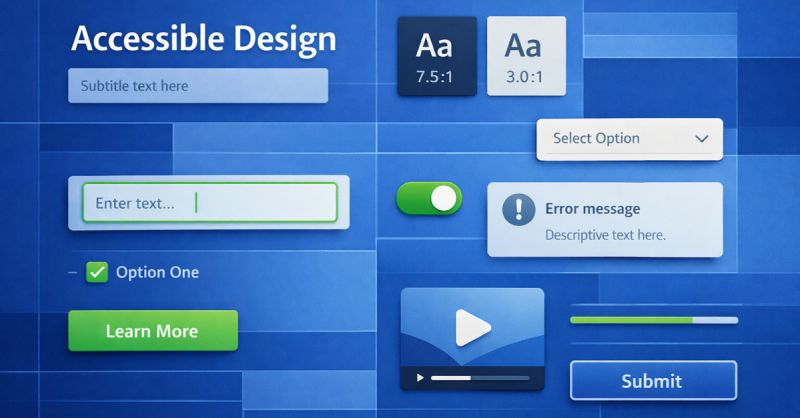
Accessibility Isn’t Optional: A Modern Guide to Inclusive UX

Accessibility is now a baseline expectation for modern digital experiences because it improves usability, reduces risk, strengthens performance, and builds trust.

Accessibility in digital design is no longer optional. It is a core component of modern UX, essential for usability, compliance, SEO performance, and brand credibility.

This guide explains what inclusive UX really means, why accessibility matters for businesses, and how organizations can implement accessible design practices that scale.

WHAT IS INCLUSIVE UX?

Inclusive UX focuses on designing digital experiences that work for people of all abilities, including users with visual, auditory, motor, cognitive, or temporary limitations. Accessibility is not a separate discipline—it is good UX applied with intention

WHY ACCESSIBILITY MATTERS

Accessible design improves usability for all users, reduces legal risk, expands audience reach, improves SEO performance, and strengthens brand trust. Clear navigation, readable typography, logical structure, and thoughtful interaction design benefit everyone.

COMMON ACCESSIBILITY MISTAKES

Many modern websites still struggle with low color contrast, inaccessible forms, missing alt text, poor keyboard navigation, and motion-heavy animations that cause usability issues.

A PRACTICAL ACCESSIBILITY CHECKLIST

  • Ensure proper color contrast and readable typography
  • Maintain clear heading hierarchy
  • Make all interactive elements keyboard accessible
  • Provide visible focus states
  • Use clear form labels and error messaging
  • Add descriptive alt text to meaningful images
  • Caption videos and avoid auto-play with sound

ACCESSIBILITY AS A SCALABLE SYSTEM

The most effective teams integrate accessibility into design systems, component libraries, QA processes, and content workflows. When accessibility is built into systems, it scales naturally as products evolve.

ACCESSIBILITY AS A UX ADVANTAGE

Accessible design leads to clearer interfaces, improved engagement, better performance across devices, and stronger SEO results. Inclusive UX is not a limitation—it is a competitive advantage.

HOW WE CAN HELP

At RPPL Studio, we design and build accessible, conversion-focused digital experiences that balance usability, performance, and brand expression.

Whether you are launching a new website, modernizing an existing platform, or building a scalable design system, our team helps ensure accessibility is embedded from the start—not added later.

If you are ready to improve accessibility, UX performance, and SEO outcomes across your digital presence, get in touch with RPPL Studio.

Visit https://rpplstudio.com or contact us to start a conversation.